5 Things I Learned About People From Doing Stand-Up Comedy
People need to put you in a box

I’ve been doing stand-up comedy for two months now, which is a total gear shift from my previous job in AI policy. I’ve learned some fascinating things about how humor works, but also about how people perceive each other, and how crowds can be surprisingly hive-minded. Here are five of those things.
1. People need to put you in a box
The first thing a stand-up audience craves, consciously or unconsciously, is for you to tell them what kind of person you are. Are you an artsy lesbian, a hard-working immigrant, a married average Joe? For some reason, people can’t laugh until they have a box to put you in. If they can’t place a comedian, half the audience’s minds will be occupied trying to figure out who is talking to them. Must be some sort of innate human drive to quickly categorize new people you meet. This is why so many stand-ups start by addressing their appearance, accent, etc. (“I know what you’re thinking… [generic punchline about their appearance].”)
I experienced this need to categorize myself when watching this set by Robby Hoffman recently. I couldn’t quite figure out who was speaking to me and just felt like I couldn’t quite settle until I got more of a grasp on who she is as a person. (This is less applicable to comedians who don’t tell stories or talk conversationally, and instead purely do one-liners. This style of comedy can feel less personal, so I suppose that’s why the urge to know more about the comedian may be lower.)
In comedy, something glaring in the audience’s mind that goes unaddressed is called a “loop”. Common loops are a strange/loud laugh in the crowd, something going wrong on stage, or mentioning something that makes the audience concerned, such as the death of a relative. Generally, comedians want to “close” such loops as quickly as possible because people just can’t laugh while thinking “She just knocked over the microphone and hasn’t addressed it!” or “Is he okay?” Some comedians go as far as to address their appearance/voice/etc. every time. Helen Bauer says she has to address being fat every time she goes on stage because there are some people in the audience to whom apparently this poses a loop.
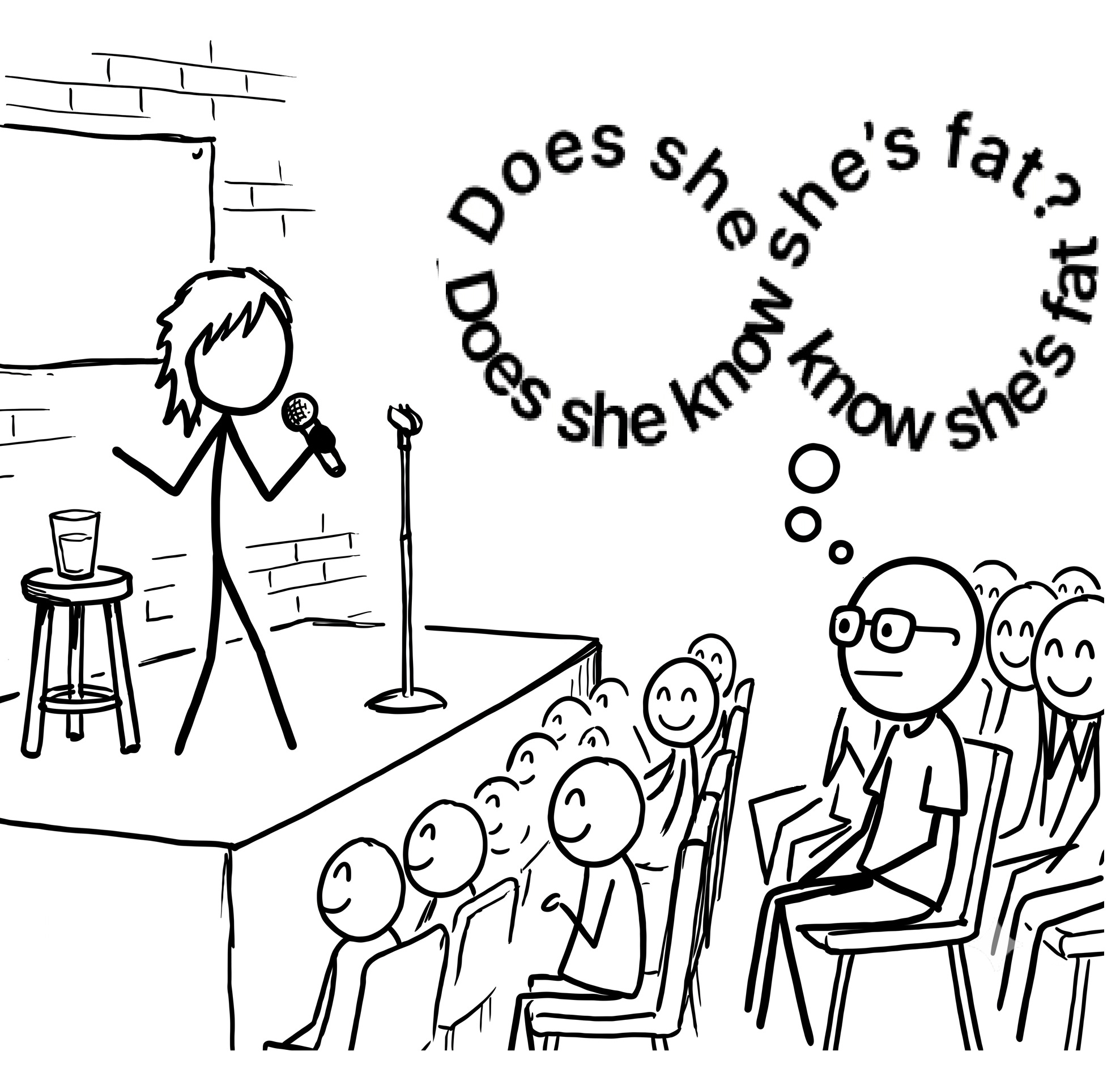
I think people’s need to categorize comedians as soon as they get on stage is basically a kind of loop. And I think the fact that people do this to comedians is indicative of people doing this in everyday life too.
2. Laughter is very un-individual
I had NO idea how un-independent people’s impulse to laugh is of the people surrounding them until I got into comedy. You will get flat responses, awkward silences, crickets one day and then roaring laughter the next with the exact same set. And it’s not a case of a few people laughing the first day while most stay silent, and the reverse the next day. People’s laughter is pretty even on a given day; people adjust to the energy in the room.
(What determines the level of energy in a room, other than the quality of the stand-up set? Probably some combination of the energy level right before the set and the presence of a couple of nutters who unconsciously do not gauge whether and how loud other people are laughing before laughing themselves. Yay, thank you, nutters.)
The thing is, most of us do not listen to a joke, evaluate it on its own terms, and decide to laugh. Instead, we are extremely sensitive to how much other people around us are laughing. If the energy is flat, we too are flat. The crazy thing is we don’t choose to laugh more or less. We simply find it more or less funny. The same person could have a completely different experience at a show, depending on the night they choose to go. And they would never know!
Meme
Please enjoy this meme, which is definitely not just here because I need a cover image for this post.
Fucking hell, finally somebody addresses this issue.
3. Different countries’ audiences differ
I suppose many people would expect different countries to have different affinities for stand-up—polite laughter in Britain, raucous crowds in Latin America, frigid Germans. I’m generally quite skeptical of such country stereotyping. But for stand-up audiences, it’s true. I can speak best to the difference between British and German audiences since I’m German—it’s huge. You could watch the funniest German stand-up clip you have ever seen on Youtube, and the audience will be giving nothing. (Little treat if you speak German.) Stand-up isn’t big in Germany at all; people aren’t that into it. British audiences are super nice in comparison!
The strange thing is, I totally get why Germans are like that. I would be like that if I hadn’t moved to the UK years ago. It’s a cultural difference in how you interact with strangers. Germans don’t talk to random people in queues or at bars, etc., in the same way that British people do. Germans don’t cheer easily or join in some sort of audience/crowdwork interaction. To a German, being that outgoing can seem fake and tacky, not to mention exhausting. (It can feel like Brits have a bit more goodwill towards their fellow woman, and honestly, having lived here for a while, maybe Germans could use more of that!)
I hear that Belgian audiences are similarly tough, and I imagine the Nordics might be even worse (or maybe that’s just my stereotypes). Reputedly, black audiences also differ from mainly-white ones, but I can’t speak to that difference myself.
4. There’s no single way to work
From my background in AI policy, I’m used to there being quite a clear model image for how to become successful in a given line of work. You want to be a researcher? Get yourself a good supervisor, produce a lot of papers, and network. Want to work in policy? Move to London (or DC), go to a million happy hours, and learn to squeeze yourself into really short attention spans. Most importantly, work a 9-7 workday Monday to Friday, or ideally, Monday to Sunday.
I’m sort of shocked at how there seems to be absolutely no theme to how successful stand-up comedians work. Not only is no one doing 9-5s, they don’t even agree on what writing looks like at a very basic level. Some comedians sit down with a pen and paper in an office, others compose lines in their head as they go about their day (wtf, how?), and finally, some nutcases go on stage with nothing more than an idea and just figure it out (??). Much in contrast to the ethos in the professional worlds I know, there just doesn’t seem to be an agreed-upon model way to become successful.
To give some examples, Nate Bargatze, one of the most successful US comedians, apparently never sits down with pen and paper. Instead, he composes his sets entirely in his head, without even writing them down. (He said this on an episode of the Good One podcast, if I remember correctly.) Judy Carter, author of the “Comedy Bible”, recommends ranting out loud about a topic to find jokes, which doesn’t click for me at all but works for many people. Many experienced comedians go on stage with little more than an idea and just riff (e.g. James Acaster does this). This is sometimes called “writing on stage”. Some comedians like Chris Rock have word-for-word scripts and choreograph their act down to the raise of an eyebrow. Maria Bamford practices her sets standing directly in front of a mirror. Others have the key notes in their head and fill in the rest.
My general sense regarding work ethic is that UK and Australian comedians are a bit laissez-faire about it. At the same time, comedians in New York (the stand-up capital of the US) will often do 2-3 shows a night. The most “sensible” comedian I know of is probably Jimmy Carr, who treats it like a 9-5 job (though surely complicated a lot by touring etc.)
I suppose what we call stand-up comedy is really a blanket term for quite a range of formats and styles. It encompasses storytelling, crowdwork and some improv, tightly scripted one-liners, characters, clowning, etc. It makes sense that the “process” differs for these. Stand-up writing is also such a personal thing, unlike, e.g., writing a research paper, so again it makes sense that the process is quite personal. The only agreed-upon parts of the success formula are, as far as I can tell, get as much stage time as possible, and be nice. Received wisdom is that doing a lot of gigs makes you better (though it’s a bit unclear to me how that trades off against writing time) and that assholes don’t get booked. You also hear many stories about people regretting not being nicer to the random MC who went on to produce [insert famous TV show here].
5. People have different senses of humor
Duh. But still, I did not fully appreciate this until I got into stand-up. People will be doubling over at sets of one-liners that will leave me absolutely cold. I don’t have much of an appreciation for clever construction of “joke” jokes, apparently. On the other hand, I will be in tears watching Sam Campbell get a hall full of people to bow to images of apes, while other people are simply confused. I’m often completely unable to tell whether a stand-up set is good or not, because it’s just not my sense of humor; it’s not for me. (E.g. I know Maria Bamford is the GOAT, but I will never understand why.)
Amy Matthews articulated it something like this on the Always Be Comedy podcast: We don’t have the same cultural fluency about different genres and tastes of comedy that we do with music or movies. If you’re not into heavy metal, you wouldn’t go to a heavy metal concert and then conclude “these musicians are shit”. But it is quite common for people to conclude “this comedian is shit” when the comedian is simply not their sense of humor. We don’t even have good names for different senses of humor, which goes to show how underappreciated these divisions in taste are. This is all just to say, if you ever see me do a set, please resist the urge (you’ll no doubt feel) to shout “You’re shit!”, and instead shout “You’re amazing at a style of comedy that just isn’t my cup of tea!” Thank you.
I hope you enjoyed this! I have a bunch more things I discovered while doing stand-up knocking around in my head, especially about the mechanics of humor and jokes. (Are some jokes unreasonably effective? What’s “persona”?) If you’d be interested in reading a post about that, please drop a comment!
Definitely room for a genres of comedy post
You're amazing at a style of writing that just isn't my cup of tea.